[Originally published in the Long Beach Union (student paper at Long Beach State), in my bi-weekly column called...]
Another Useless Column
I have to share a conversation I overheard the other day. Returning to work from lunch, I came in just behind two women who had been outside on a smoke break. One, approaching middle age, was telling birth stories to the other, clearly younger, woman, who listened with the earnestness of one who has never been pregnant.
As we climbed the stairs to the second floor, the older woman noted that she was lighting up virtually the minute she was out of the delivery room.
The most difficult part of childbirth, apparently, had been going hours without a cigarette.
At the top of the stairs, they walked in the opposite direction from me, but before they were too far away, I heard the younger woman say she might have to have an abortion if pregnancy meant nine months of tobacco abstinence.
Now, you reaction to that may have been: “What a horrible thing to even joke about!” Or you may have thought, “Yeah, nine months without a smoke, that’s rough.” Or you may still be reeling from seeing Al Gore do the Macarena, and can’t concentrate.
Whatever your opinion, like abortion, you believe it strongly.
Me? I say, hey, it’s a free country. Well, sort of.
For the record, I don’t smoke. Never have. My mother smokes, as do many of my friends. Children of parents who smoke tend to either become smokers themselves or ardent anti-smokers. I fall into the latter category, but the interesting thing is that I find I am only bothered by strangers who smoke. I’m not crazy about the fact that my mother smokes, but when I’m around her, she’s not a smoker, she’s just Mom.
Hypocritical? Of course. But we can overlook unpleasant habits in our acquaintances. We’re aware of at least some redeeming aspect they possess. That stranger whose cigarette smoke wafts too close is just an inconsiderate asshole.
I think it’s important to draw a distinction between people who smoke and smokers. The former are people who engage in inhaling the fumes of burnt tobacco (and nicotine, etc.). The latter are people for whom this practice is their defining characteristic. Think what you will about the younger woman in the aforementioned exchange, but at least she knows better than to get pregnant.
A certain camaraderie exists amongst smokers. Perhaps they bond as members of a persecuted group. Maybe it’s the fact that one can tell at a glance, “Hey, there’s someone else who’s choosing to do horrible things to their lungs.” It’s a support group kind of thing: a smoker isn’t going to give a fellow smoker a hard time.
Yes, smoking’s bad, yadda yadda yadda. But we should all exercise more. We shouldn’t eat so much fried food. Hell, we should escape this smog-infested armpit of the world if we’re really concerned about our health.
In a way, smokers have an advantage that we non‑smokers don’t: someday, when they get cancer, they’ll know exactly why, and they will have had years of nicotine-enriched pleasure getting it. When we non‑smokers come down with terrible illnesses, we won’t know who to blame. Smokers can look to the tobacco industry and the beautifully evil people who run it and say, “Thank you, it’s all your fault.”
The clever demons who produce cigarettes have made their product terrifically addictive. Despicable, yes, but perversely admirable in a business sense.
However, this just keeps the customer coming back. What makes someone start? Who knows for sure. Peer pressure? Advertising? I have to wonder, “Could the most amazing ads sway people to subject themselves to something so clearly bad if they didn’t have a predilection for it in the first place?”
Anyone influenced by cigarette ads gets what they deserve. Have some self-esteem, take some responsibility. Be young, have fun, drink Pepsi. Hey, wait a second…
Monday, September 16, 1996
Tuesday, September 03, 1996
AUC: Nowhere to go but up… must we go?
[Originally published in the Long Beach Union (student paper at Long Beach State), in my bi-weekly column called...]
Another Useless Column
Ah, the first week of the semester, when no matter how much you procrastinate, you can’t be more than a week behind in your classwork. This is going to be it: this is the semester you make it to class every day, take good notes, read the assignment before it’s due, and are prepared enough to get a good night’s sleep before the exam. Yes, this semester will be different.
Sure.
Here’s a little suggestion for you: expect to fall back into your abysmal habits, expect to fall behind in your studies, expect to be willing to sell your soul the week before finals.
This may seem pessimistic, but it’s in the best interests of you self-esteem. Really.
Rather than going into this semester with high hopes of academic success—which, let’s face it, history dictates most of us don’t quite live up to—set your sights lower. Instead, think: This semester I’m going to sleep through my morning classes, hang out with my friends instead of attending my afternoon classes, blow off studying in the evening to watch television, and I’ll fail miserably.
One of two things will happen: either you’ll actually get off you duff and do something and manage to pass all your classes, or the above pattern will prove to be your fate. If the former is the case, then imagine your delight when you have so amazingly exceeded your expectations that you will actually feel good about yourself for a while. If the latter comes to pass, well, you can take heart in knowing that you can set a goal and stick to it. You really can’t be disappointed either way.
Of course, you should be warned that if you happen to pass, it will be more difficult to return to your underachieving ways next semester, and you may be tempted to have aspirations again.
Remember, kids, the more classes you pass, the sooner you’ll graduate, and then you’ll have to do something with your life. But on the off-chance that you do eventually get a degree, do not fall prey to the sort of thinking that these collegiate years will make some difference in the rest of your life. Again, they may or may not, and if they do, hey, great. However, if college proves to have left you unprepared for the future, at least you didn’t expect any differently, and all those student loans you have to repay will not be a constant reminder of unrealized potential but just another pleasant debt you incurred along the road of life.
And then one day, as the sun sets on your life and you reflect back on it, you can think: Well, I did lead a life of quiet desperation, but that’s all I ever thought it would be. Thus, you can die a reasonably ambivalent person.
It’s all a matter of setting realistic goals, and expecting much less.
Another Useless Column
Ah, the first week of the semester, when no matter how much you procrastinate, you can’t be more than a week behind in your classwork. This is going to be it: this is the semester you make it to class every day, take good notes, read the assignment before it’s due, and are prepared enough to get a good night’s sleep before the exam. Yes, this semester will be different.
Sure.
Here’s a little suggestion for you: expect to fall back into your abysmal habits, expect to fall behind in your studies, expect to be willing to sell your soul the week before finals.
This may seem pessimistic, but it’s in the best interests of you self-esteem. Really.
Rather than going into this semester with high hopes of academic success—which, let’s face it, history dictates most of us don’t quite live up to—set your sights lower. Instead, think: This semester I’m going to sleep through my morning classes, hang out with my friends instead of attending my afternoon classes, blow off studying in the evening to watch television, and I’ll fail miserably.
One of two things will happen: either you’ll actually get off you duff and do something and manage to pass all your classes, or the above pattern will prove to be your fate. If the former is the case, then imagine your delight when you have so amazingly exceeded your expectations that you will actually feel good about yourself for a while. If the latter comes to pass, well, you can take heart in knowing that you can set a goal and stick to it. You really can’t be disappointed either way.
Of course, you should be warned that if you happen to pass, it will be more difficult to return to your underachieving ways next semester, and you may be tempted to have aspirations again.
Remember, kids, the more classes you pass, the sooner you’ll graduate, and then you’ll have to do something with your life. But on the off-chance that you do eventually get a degree, do not fall prey to the sort of thinking that these collegiate years will make some difference in the rest of your life. Again, they may or may not, and if they do, hey, great. However, if college proves to have left you unprepared for the future, at least you didn’t expect any differently, and all those student loans you have to repay will not be a constant reminder of unrealized potential but just another pleasant debt you incurred along the road of life.
And then one day, as the sun sets on your life and you reflect back on it, you can think: Well, I did lead a life of quiet desperation, but that’s all I ever thought it would be. Thus, you can die a reasonably ambivalent person.
It’s all a matter of setting realistic goals, and expecting much less.
Monday, May 06, 1996
AUC: Being happy? It’s all in your head
[Originally published in the Long Beach Union (student paper at Long Beach State), in my occasional column called...]
Another Useless Column
As a member of the post-Boomer generation, I realize I’m supposed to be cynical and crass and filled with ennui. Now don’t get me wrong: I have more than adequate levels of cynicism to get into the meetings.
Between the national debt, pollution, injustice, the economy, general uncertainty about the future, and the fact that Joey Lawrence still has a career, I think no one could blame us if we all became card-carrying nihilists.
At the risk of getting kicked out of the club, however, I have a confession.
I’m kind of happy with my life at the moment.
I know, I know. I’m as surprised as you. My life is far from perfect, mind you, but hell, I’ve never had any disputes resolved on a daytime talk show.
Everyone wants to be happy. Well, everyone except Morrissey, but that’s only because it would be a bad career move.
So what makes people happy? Who knows? Perhaps that’s the problem: some people haven’t figured out what brings happiness. That, or maybe we really do lead a pointless existence in a Godless universe where nothing we do matters. I’m on the fence on that one.
Speaking for myself, my present lack of dissatisfaction can be traced to a simple fact: I’ve been down, and I’m not there anymore. I lived through self-esteem shattering effects of getting divorced, getting laid off, and being unemployed and broke for months. (The worst part of having nothing to do is that it gives one so much time to contemplate how lousy things are, with every passing day dragging one deeper into despair.)
Somehow, I survived, and when my fortunes turned, I was extremely appreciative. I lucked out and got a not-horrible job. I began writing for this rag and met a lot of cool folks. I actually had money to socialize again.
Perhaps that’s it: people. We crave interaction. Except maybe Ted Kaczinsky. But for the most part, we are social animals. The irony, of course, is that people often are the greatest source of aggravation in people’s lives. The other irony is that happiness must come from within, and yet we become [sic] look outward. Ain’t we screwy.
And mere platonic friendship isn’t quite enough. The search for that special someone proves a major concern in the quest for happiness. We long to find that person whose neuroses jibe with our own, and we dub it love. And darn if it isn’t just the best distraction there is. Oh wait. That’s sex.
Sorry. I’m sounding sarcastic. Love is good. Honest. Sincerely. I recommend it highly. Get back on the horse, no matter how often you’re thrown.
Alert readers have probably discerned another large component of why my malaise-meter is reading so low: yes, I’ve met someone I like a lot who seems to like me back. I don’t know what will come of it. Oh sure, my cynical side gnaws at me, wondering when it’s all going to blow up in my face, but for now I’m reveling in the moment.
Perhaps that’s it: setting the joy-telescopes to pick up the light in the dim stars rather than waiting for the full illumination of dawn.
Or maybe it’s a matter of perfecting the art of self-deception. In the end, whether you’re genuinely happy or just think you are, isn’t the effect the same in the end? [sic]
[2006 note: Hell of an editing job, eh?]
Another Useless Column
As a member of the post-Boomer generation, I realize I’m supposed to be cynical and crass and filled with ennui. Now don’t get me wrong: I have more than adequate levels of cynicism to get into the meetings.
Between the national debt, pollution, injustice, the economy, general uncertainty about the future, and the fact that Joey Lawrence still has a career, I think no one could blame us if we all became card-carrying nihilists.
At the risk of getting kicked out of the club, however, I have a confession.
I’m kind of happy with my life at the moment.
I know, I know. I’m as surprised as you. My life is far from perfect, mind you, but hell, I’ve never had any disputes resolved on a daytime talk show.
Everyone wants to be happy. Well, everyone except Morrissey, but that’s only because it would be a bad career move.
So what makes people happy? Who knows? Perhaps that’s the problem: some people haven’t figured out what brings happiness. That, or maybe we really do lead a pointless existence in a Godless universe where nothing we do matters. I’m on the fence on that one.
Speaking for myself, my present lack of dissatisfaction can be traced to a simple fact: I’ve been down, and I’m not there anymore. I lived through self-esteem shattering effects of getting divorced, getting laid off, and being unemployed and broke for months. (The worst part of having nothing to do is that it gives one so much time to contemplate how lousy things are, with every passing day dragging one deeper into despair.)
Somehow, I survived, and when my fortunes turned, I was extremely appreciative. I lucked out and got a not-horrible job. I began writing for this rag and met a lot of cool folks. I actually had money to socialize again.
Perhaps that’s it: people. We crave interaction. Except maybe Ted Kaczinsky. But for the most part, we are social animals. The irony, of course, is that people often are the greatest source of aggravation in people’s lives. The other irony is that happiness must come from within, and yet we become [sic] look outward. Ain’t we screwy.
And mere platonic friendship isn’t quite enough. The search for that special someone proves a major concern in the quest for happiness. We long to find that person whose neuroses jibe with our own, and we dub it love. And darn if it isn’t just the best distraction there is. Oh wait. That’s sex.
Sorry. I’m sounding sarcastic. Love is good. Honest. Sincerely. I recommend it highly. Get back on the horse, no matter how often you’re thrown.
Alert readers have probably discerned another large component of why my malaise-meter is reading so low: yes, I’ve met someone I like a lot who seems to like me back. I don’t know what will come of it. Oh sure, my cynical side gnaws at me, wondering when it’s all going to blow up in my face, but for now I’m reveling in the moment.
Perhaps that’s it: setting the joy-telescopes to pick up the light in the dim stars rather than waiting for the full illumination of dawn.
Or maybe it’s a matter of perfecting the art of self-deception. In the end, whether you’re genuinely happy or just think you are, isn’t the effect the same in the end? [sic]
[2006 note: Hell of an editing job, eh?]
Age of Reason (Paul Westerberg review)
[The following is a review I wrote for the Music page of the Long Beach Union, the student paper at Long Beach State.]
Age of Reason
Paul Westerberg is getting older. But then, aren’t we all?
In his younger days, he fronted the seminal Minneapolis post-punk band the Replacements. The debauchery of their live shows often outshined Westerberg’s brilliant songwriting.
After the group broke up, many expected Westerberg’s first solo album (14 Songs) to be a reserved work focused on the songwriting. Instead, it proved a diverse collection, with lush ballads, unabashed rockers, and ever a song recorded in one take in his kitchen.
Three years later, Westerberg’s sophomore effort, Eventually, finds the 36 year-old contemplating life differently than he did in the wild days of youth.
Eventually flows more like a proper album than did 14 Songs. I’m not sure if that’s good or not.
The album opens with the contemplative “These Are The Days,” then segues into the semi-political “Century.” Of course, politics Westerberg style is not scathing, rather merely commenting: “The only ones standing after your speech/Are the ones with mops and the brooms and the keys.”
The standout track is the pensive “Hide n Seekin’,” which picks up on the threads of the Replacements’ “Here Comes a Regular.” A lone guitar, accompanied by brushes on a snare and a lilty flute, provides the backdrop for the song’s bar scene, where the narrator dismisses with the game-playing of youth: “Hide ‘n seekin’s for children, baby/Now it’s hid and saw.”
In the country song “Once Around the Weekend,” he accepts the slower pace of life, noting “I stay in every night of the week.” He can appreciate the quieter moments in life (or at least can remember them).
Even the angst (inasmuch as there is any) comes across in a somewhat detached way. In “MamaDaddyDid,” Westerberg sings, “Decided not to raise any children/Just like my Ma-ma-mama Daddy did.” Rather than seeming a bitter criticism, however, it comes across as accepting of the parents’ inadequacies. Westerberg’s gotten over it.
There’s also a certain optimism permeating the songs, most obvious in the piano ballad “Good Day.” Perhaps the death of former Replacements’ guitarist Bob Stinson last year made Westerberg appreciate things, as evidenced by the lines: “Sing along/Hold my life/A good day/Is any day that you’re alive.”
The rockers, like “You’ve Had It With You,” don’t succeed as well as some cuts. Westerberg can still turn out power pop tunes with the best of them, but they aren’t his best material.
I guess that’s the thing about Westerberg: he really is one of the best songwriters out there, so I apply higher standards to him.
Eventually is an outstanding album. It far exceeds most of what’s out there today. So will it receive the attention it deserves? Probably not.
If you want to hear what bands like the Goo Goo Dolls will sound like in a few years, you can hear it now by picking up Paul Westerberg. No matter how old you feel.
Age of Reason
Paul Westerberg is getting older. But then, aren’t we all?
In his younger days, he fronted the seminal Minneapolis post-punk band the Replacements. The debauchery of their live shows often outshined Westerberg’s brilliant songwriting.
After the group broke up, many expected Westerberg’s first solo album (14 Songs) to be a reserved work focused on the songwriting. Instead, it proved a diverse collection, with lush ballads, unabashed rockers, and ever a song recorded in one take in his kitchen.
Three years later, Westerberg’s sophomore effort, Eventually, finds the 36 year-old contemplating life differently than he did in the wild days of youth.
Eventually flows more like a proper album than did 14 Songs. I’m not sure if that’s good or not.
The album opens with the contemplative “These Are The Days,” then segues into the semi-political “Century.” Of course, politics Westerberg style is not scathing, rather merely commenting: “The only ones standing after your speech/Are the ones with mops and the brooms and the keys.”
The standout track is the pensive “Hide n Seekin’,” which picks up on the threads of the Replacements’ “Here Comes a Regular.” A lone guitar, accompanied by brushes on a snare and a lilty flute, provides the backdrop for the song’s bar scene, where the narrator dismisses with the game-playing of youth: “Hide ‘n seekin’s for children, baby/Now it’s hid and saw.”
In the country song “Once Around the Weekend,” he accepts the slower pace of life, noting “I stay in every night of the week.” He can appreciate the quieter moments in life (or at least can remember them).
Even the angst (inasmuch as there is any) comes across in a somewhat detached way. In “MamaDaddyDid,” Westerberg sings, “Decided not to raise any children/Just like my Ma-ma-mama Daddy did.” Rather than seeming a bitter criticism, however, it comes across as accepting of the parents’ inadequacies. Westerberg’s gotten over it.
There’s also a certain optimism permeating the songs, most obvious in the piano ballad “Good Day.” Perhaps the death of former Replacements’ guitarist Bob Stinson last year made Westerberg appreciate things, as evidenced by the lines: “Sing along/Hold my life/A good day/Is any day that you’re alive.”
The rockers, like “You’ve Had It With You,” don’t succeed as well as some cuts. Westerberg can still turn out power pop tunes with the best of them, but they aren’t his best material.
I guess that’s the thing about Westerberg: he really is one of the best songwriters out there, so I apply higher standards to him.
Eventually is an outstanding album. It far exceeds most of what’s out there today. So will it receive the attention it deserves? Probably not.
If you want to hear what bands like the Goo Goo Dolls will sound like in a few years, you can hear it now by picking up Paul Westerberg. No matter how old you feel.
Monday, March 04, 1996
Grunion: CSU trustees to order school uniforms
[The following is from the Grunion (satire page--at least it was at the time--of the Long Beach Union, student newspaper at Long Beach State), published March 4, 1996]
CSU trustees to order school uniforms
By Morty Arthur
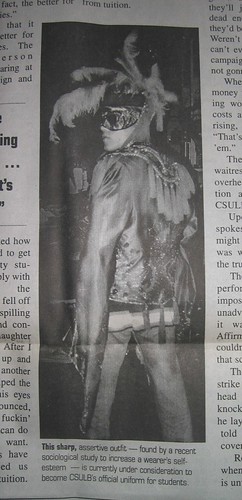
Grossly influenced by President Clinton’s remarks during a recent visit to a local school, the California State University Board of Trustees has tentatively approved a plan to require CSU students to wear uniforms while on campus, a spokesperson inadvertently mentioned while drunk at a local pub.
The trustees intend to implement a test run of the plan next semester here at CSULB, envious of the attention bestowed upon Long Beach’s Jackie Robinson Academy for being the first school to mandate student wardrobe.

“We heard Clinton commending them for this uniform thing, and we got this idea,” the spokesperson uttered. “Yeah, we did. Not the UC Regents, us. We’re sick of the UC Regents always making decisions and getting the glory. We can do stuff, too. We didn’t get rid of affirmative action like they did—although that was because we got bribes.”
Addressing the decision behind using CSULB as the experiment, the spokesperson stated, “Obviously, kids in Long Beach will do anything anybody tells ‘em, so we figured the college kids must be equally spineless. Hell, I can’t believe the students at Cal State Long Beach can still enunciate, considering what’s really coming out that power plant they call a water heater.” The spokesperson then laughed maniacally and staggered off to the restroom before he could elaborate.
We he returned (his fly open), I asked him if the Trustees intended to ease racial tension on campus, as were the findings in the lower grades. “Tension-smension, as long as we’re rich,” he replied.
The spokesperson rambled on semi-deliriously, grasping his glass as though it were a jewel. I was forced to threaten him with the wrath of the genie of the lamp to get him to explain. Staring absently at the broken Zima neon sign, he noted that the appeal of the uniforms for the Trustees was the opportunity to sell advertising on the uniforms, much like riders in the Tour de France, from which the Trustees would receive a percentage.
He alluded to the arrangement Sprint has made with a number of universities, including CSULB, whereby they can advertise on the student i.d. cards. Apparently, many large corporations were “very interested” by the idea, seeing the college-aged consumers as a lucrative demographic.
“That’s all they’re good for,” the spokesperson concluded, “so the sooner they accept that fact, the better for the companies.”
I added that it was also better for the trustees. The spokesperson resumed staring at the Zima sign and smiling.
When asked how they intended to get the university students to comply with the plan, the spokesperson fell off his barstool, spilling his drink, and convulsed with laughter on the floor. After I helped him up and he ordered another round, he wiped the tears from his eyes and announced, “We’re the fuckin’ trustees. We can do anything we want. The students have never stopped us from raising tuition. They the losers who couldn’t get into decent schools. What can they do?”
I said they could drop out, thus reducing the revenues from tuition.
“Yeah, sure,” the spokesperson retorted. “We’ve got ‘em all so convinced that the only way to succeed is to get a degree—even though they’ll just end up in some dead-end job anyway—that they’d be too scared to do that. Weren’t you listening? They can’t even coordinate a letter campaign over tuition. They’re not gonna rock the boat.”
When asked if some of the uniform advertising would be used to offset costs and keep tuitions from rising, the spokesperson said, “That’s what we’re gonna tell ‘em.”
The African-American waitress who was serving us overheard part of the conversation and noted she was a CSULB student.
Upon hearing this, the spokesperson mentioned he might be able to help her, if she was willing to “comply with the trustees’ wishes.”
The waitress told him perform an anatomically-impossible act, to which he unadvisedly replied, “Look, if it wasn’t for us keeping Affirmative Action, your kind couldn’t have even gotten into that school!”
The waitress proceeded to strike the spokesperson in the head with her tray. He was knocked unconscious, and as he lay sprawled on the floor, I told the waitress he would cover my tab.
Remember to act surprised when the new uniform policy is unveiled.
CSU trustees to order school uniforms
By Morty Arthur
Grossly influenced by President Clinton’s remarks during a recent visit to a local school, the California State University Board of Trustees has tentatively approved a plan to require CSU students to wear uniforms while on campus, a spokesperson inadvertently mentioned while drunk at a local pub.
The trustees intend to implement a test run of the plan next semester here at CSULB, envious of the attention bestowed upon Long Beach’s Jackie Robinson Academy for being the first school to mandate student wardrobe.
“We heard Clinton commending them for this uniform thing, and we got this idea,” the spokesperson uttered. “Yeah, we did. Not the UC Regents, us. We’re sick of the UC Regents always making decisions and getting the glory. We can do stuff, too. We didn’t get rid of affirmative action like they did—although that was because we got bribes.”
Addressing the decision behind using CSULB as the experiment, the spokesperson stated, “Obviously, kids in Long Beach will do anything anybody tells ‘em, so we figured the college kids must be equally spineless. Hell, I can’t believe the students at Cal State Long Beach can still enunciate, considering what’s really coming out that power plant they call a water heater.” The spokesperson then laughed maniacally and staggered off to the restroom before he could elaborate.
We he returned (his fly open), I asked him if the Trustees intended to ease racial tension on campus, as were the findings in the lower grades. “Tension-smension, as long as we’re rich,” he replied.
The spokesperson rambled on semi-deliriously, grasping his glass as though it were a jewel. I was forced to threaten him with the wrath of the genie of the lamp to get him to explain. Staring absently at the broken Zima neon sign, he noted that the appeal of the uniforms for the Trustees was the opportunity to sell advertising on the uniforms, much like riders in the Tour de France, from which the Trustees would receive a percentage.
He alluded to the arrangement Sprint has made with a number of universities, including CSULB, whereby they can advertise on the student i.d. cards. Apparently, many large corporations were “very interested” by the idea, seeing the college-aged consumers as a lucrative demographic.
“That’s all they’re good for,” the spokesperson concluded, “so the sooner they accept that fact, the better for the companies.”
I added that it was also better for the trustees. The spokesperson resumed staring at the Zima sign and smiling.
When asked how they intended to get the university students to comply with the plan, the spokesperson fell off his barstool, spilling his drink, and convulsed with laughter on the floor. After I helped him up and he ordered another round, he wiped the tears from his eyes and announced, “We’re the fuckin’ trustees. We can do anything we want. The students have never stopped us from raising tuition. They the losers who couldn’t get into decent schools. What can they do?”
I said they could drop out, thus reducing the revenues from tuition.
“Yeah, sure,” the spokesperson retorted. “We’ve got ‘em all so convinced that the only way to succeed is to get a degree—even though they’ll just end up in some dead-end job anyway—that they’d be too scared to do that. Weren’t you listening? They can’t even coordinate a letter campaign over tuition. They’re not gonna rock the boat.”
When asked if some of the uniform advertising would be used to offset costs and keep tuitions from rising, the spokesperson said, “That’s what we’re gonna tell ‘em.”
The African-American waitress who was serving us overheard part of the conversation and noted she was a CSULB student.
Upon hearing this, the spokesperson mentioned he might be able to help her, if she was willing to “comply with the trustees’ wishes.”
The waitress told him perform an anatomically-impossible act, to which he unadvisedly replied, “Look, if it wasn’t for us keeping Affirmative Action, your kind couldn’t have even gotten into that school!”
The waitress proceeded to strike the spokesperson in the head with her tray. He was knocked unconscious, and as he lay sprawled on the floor, I told the waitress he would cover my tab.
Remember to act surprised when the new uniform policy is unveiled.
Subscribe to:
Posts (Atom)