Back in May I expressed concern over where they would go on "The Office" after the way last season ended, but after seeing tonight's premiere, I must say: It's just as good.
That's all. I apologize to the writers for doubting them.
Thursday, September 21, 2006
Wednesday, September 20, 2006
The new thing for the web: paper
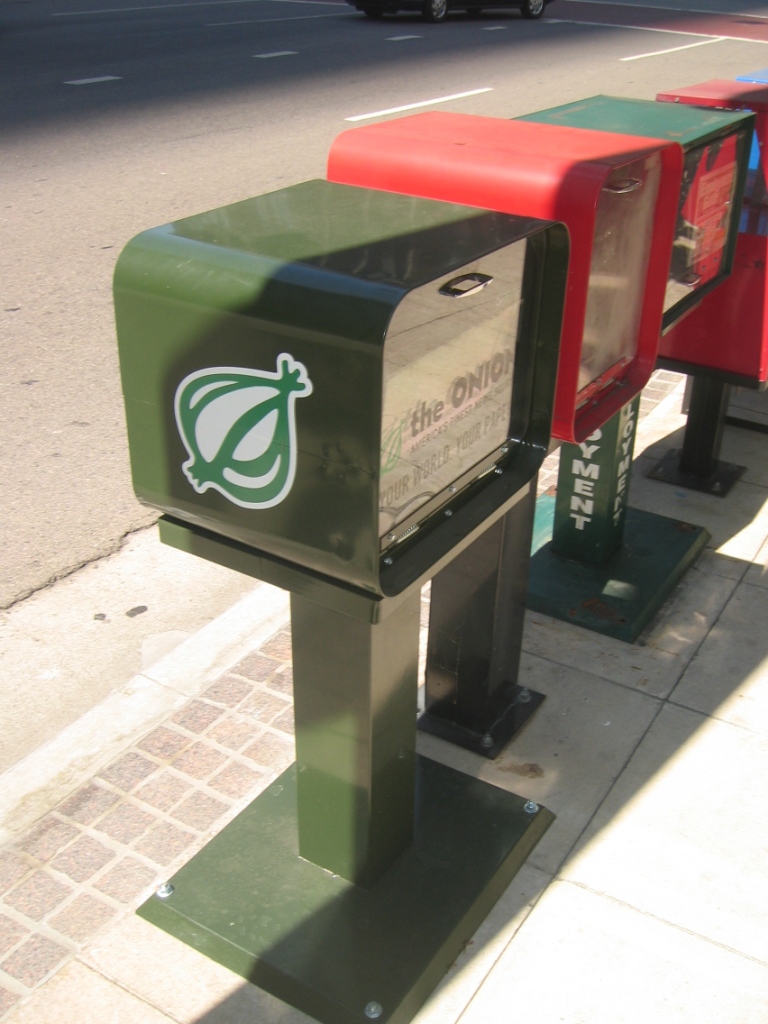
Last month The Onion started publishing an actual weekly paper, and (the best part) it's free (like LA Weekly or City Beat). Sure, it has ads, but that's fine; finally I will have something to peruse at lunch that I would read even if it wasn't free. (The weekly rags are not without their interesting sections, but they're on my radar because they're convenient--available on street corners around downtown--not because they're the epitome of entertainment and/or information.)
I must admit I rarely remember to check the Onion's website, even though I know I would find it entertaining if I did. Not everything there is great, but it's at least reasonably funny. And by virtue of having not read the website, what gets printed in the newsprint edition is new to me when it comes out.
I am too old school in my reading habits, relying still on the printed page. Heck, sometimes I'll even print out entries from what I do "read" online to read when I'm on the train or at lunch.
I'm not sure whether it's a matter of the computer monitor being a less-than-ideal conduit for reading material, or that when at the computer one feels compelled to do something (engage in an activity requiring interaction) and so it becomes more difficult to wrap the mind around merely reading words. Perhaps it's a matter of being accustomed to reading from books or magazines and needing to readjust to reading online. With email, for example, that has only ever been on the computer, so reading that there creates no need to reconcile anything in the mind about what one is doing and the medium on which one is doing it.
As far as I can tell, there are those who are inclined to read text-heavy pieces on the screen (be they websites or manuals or documents and there are those who aren't. I'm not sure what makes one more likely to be one or the other. It may be fascination with technology that gives one a greater proclivity toward the former. For the latter, I imagine it may revolve more around the tactile satisfaction derived from turning the page with what's printed on paper. There's that tiny sense of accomplishment by having made it through another 250 or so words; it's not the same as finishing the piece, of course, but there's some semblance of milestone having been reached along the way.
There's no way to put slip of paper between pages to mark how far one has read when one is reading on a screen. (And any technological methods for approximating that simply aren't the same.)
It is inevitable that as the medium for reading changes more and more to being a computer screen (particularly in a web-based format) rather than being paper (be it newsprint or glossy or 8.5 x 11 white), the style in which what is written will change. That is, because it's more difficult to read longer pieces on a monitor (perhaps because one is not inclined, but also because it's trickier to keep one's place), what is written will become more succinct. Certainly that has already started, but I'm talking about the long-term ramifications of that. It has been argued that television has had the effect of reducing our attention span; might the expansion of "publishing" only to the web, not on paper, cause us to fail to be able to read anything longer than a few paragraphs?
(And oh boy, how screwed will I be then! No one will even get this far.)
Might it change the way writing is taught in schools? It seems impossible it wouldn't have some effect on the educational system. (I'd rather not consider that in depth now, because I can sense you're already fading this deep into this post.)
This is not a good era for me, and it will only get worse. Yet I try to adapt. Here's what I'll do: Keep blathering on, but try to not blather quite so much. And here's what I suggest you do:
Print out these posts, and read them during your lunch. It's a compromise for this new paradigm, into which it's questionable how well I'll fit, but I'll try.
And recycle the paper when you're done! Never let it be said I have no concern for the future, even though the one that internet is steering us toward is destroying my readership's ability to pay attention to the end. While, admittedly, simultaneously facilitating that readership.
Ah, the irony.
Tuesday, September 19, 2006
Quagmire

Why do we need alternative energy when there's plenty of sulfurous gas emerging from the La Brea tarpits? Can't we harness that? May have to move the mastodons, admittedly...
(photo taken July 1, by yours truly, for those of you who need such details)
Effective politics: Automatic for the propositions
There's a proposition on the upcoming California ballot that is drawing more attention than even the gubernatorial race (I can't believe I spelled "gubernatorial" correctly on the first try—trust me, I did): Prop. 87. It apparently involves taxing oil companies for drilling in the state, and using the money for researching alternative energies, but apparently creating a new under-regulated bureaucracy for this research. The proponents and opponents are trying to pick apart the other's argument in their ads, as one would expect, and I admit up front that's the only thing I have to comment on: their ads.
What is most interesting to me is the skill of their marketing, especially on the pro side. This morning, as I put on my shoes, I watched a few minutes of TV, stopping on one of the local station's morning "news" program. And during a single commercial break—that is, during one set of commercials interrupting the program—I saw an ad by the opposing side (where they use an actor in a firefighter's jacket to explain what a bad idea the tax is), then another ad (I don't recall for what), and then an ad from the pro side that specifically refuted the claims made two commercials previous (even showing a close-up of the end of the prior ad, zooming in on the fine print that notes those who paid for the ad and showing the name of one of the major oil companies).
I thought to myself, Egad, how much do they pay to schedule their commercial so that the other side's message doesn't even get to linger longer than 30 seconds?
I am not suggesting it's the most clever argument on the pro side; of course the oil companies are behind the ads trying to convince the voters the proposition is bad, because from their perspective it is. When it comes to trying to convince the voters it's good, the pro side seems to rely heavily on implicitly punishing the oil companies because they made a $78 billion profit last year. The use of the money raised by the tax seems something of an afterthought; my impression of their argument for the proposition (as opposed to their argument against the opposition), based on seeing their other ad many times, was more or less: Hey, the oil companies can afford to be taxed so let's do it; they've been sticking it to you at the pump, so here's your chance to extract revenge. Oh, and eventually it may actually have some benefit for the environment.
That's probably effective enough to get it to pass. Whatever pangs of guilt many might feel over just taxing them for being profitable should be assuaged by the suggestion of what might come. There's no effort at trying to convince the people it's necessarily fair—they made that profit because the voters purchased their product, after all—but rather at appealing to their emotions, both base and altruistic.
I seems like those same people who tried to organize the don't-buy-gas-on-this-day events (that were probably fake) finally realized that wasn't going to happen and devoted their efforts to getting this on the ballot. Which is smart. Because this doesn't require them to make any sacrifice for the greater good, other than bother to actually go to their polling place.
That, of course, is more than those interested in either punishing the oil companies or in allowing them to keep their lucre have reason to expect from the average television viewer, but since it's not a matter of one side or the other getting a majority of the actual populace to vote for their side but to get a majority of those who bother to vote to cast ballots in their favor, so it's still worth their respective whiles to spend the money on such advertising. They certainly need not worry too much about the average viewer who will likely vote to bother reading the particulars of the proposition (and even if that average viewer tried to read said particulars, it's not likely even a college-educated individual could make heads or tails of what it would really entail, if passed, or what consequences may emerge from it failing to pass).
That is a hideously glib statement about the nature of the process. Still, I think it more or less valid. I don't think the point of politics is for the average person to understand it, and I think the average person is probably far happier not understanding it. I am, it should be obvious, not one with much of an optimistic belief about the process of governing. The role of those in power is not to do what's best for those being governed but to do what allows those in power to remain so, thus ostensible benefits for the governed is as effective as actual benefits for the governed (and the latter are probably more coincidental than intentional). I don't expect my elected officials to be working in my favor, and hence I am not disappointed when they don't do so.
But the people working for both sides of the Prop. 87 are doing one hell of a bang-up job. If they work this hard after the election, something might actually get done.
What is most interesting to me is the skill of their marketing, especially on the pro side. This morning, as I put on my shoes, I watched a few minutes of TV, stopping on one of the local station's morning "news" program. And during a single commercial break—that is, during one set of commercials interrupting the program—I saw an ad by the opposing side (where they use an actor in a firefighter's jacket to explain what a bad idea the tax is), then another ad (I don't recall for what), and then an ad from the pro side that specifically refuted the claims made two commercials previous (even showing a close-up of the end of the prior ad, zooming in on the fine print that notes those who paid for the ad and showing the name of one of the major oil companies).
I thought to myself, Egad, how much do they pay to schedule their commercial so that the other side's message doesn't even get to linger longer than 30 seconds?
I am not suggesting it's the most clever argument on the pro side; of course the oil companies are behind the ads trying to convince the voters the proposition is bad, because from their perspective it is. When it comes to trying to convince the voters it's good, the pro side seems to rely heavily on implicitly punishing the oil companies because they made a $78 billion profit last year. The use of the money raised by the tax seems something of an afterthought; my impression of their argument for the proposition (as opposed to their argument against the opposition), based on seeing their other ad many times, was more or less: Hey, the oil companies can afford to be taxed so let's do it; they've been sticking it to you at the pump, so here's your chance to extract revenge. Oh, and eventually it may actually have some benefit for the environment.
That's probably effective enough to get it to pass. Whatever pangs of guilt many might feel over just taxing them for being profitable should be assuaged by the suggestion of what might come. There's no effort at trying to convince the people it's necessarily fair—they made that profit because the voters purchased their product, after all—but rather at appealing to their emotions, both base and altruistic.
I seems like those same people who tried to organize the don't-buy-gas-on-this-day events (that were probably fake) finally realized that wasn't going to happen and devoted their efforts to getting this on the ballot. Which is smart. Because this doesn't require them to make any sacrifice for the greater good, other than bother to actually go to their polling place.
That, of course, is more than those interested in either punishing the oil companies or in allowing them to keep their lucre have reason to expect from the average television viewer, but since it's not a matter of one side or the other getting a majority of the actual populace to vote for their side but to get a majority of those who bother to vote to cast ballots in their favor, so it's still worth their respective whiles to spend the money on such advertising. They certainly need not worry too much about the average viewer who will likely vote to bother reading the particulars of the proposition (and even if that average viewer tried to read said particulars, it's not likely even a college-educated individual could make heads or tails of what it would really entail, if passed, or what consequences may emerge from it failing to pass).
That is a hideously glib statement about the nature of the process. Still, I think it more or less valid. I don't think the point of politics is for the average person to understand it, and I think the average person is probably far happier not understanding it. I am, it should be obvious, not one with much of an optimistic belief about the process of governing. The role of those in power is not to do what's best for those being governed but to do what allows those in power to remain so, thus ostensible benefits for the governed is as effective as actual benefits for the governed (and the latter are probably more coincidental than intentional). I don't expect my elected officials to be working in my favor, and hence I am not disappointed when they don't do so.
But the people working for both sides of the Prop. 87 are doing one hell of a bang-up job. If they work this hard after the election, something might actually get done.
Sunday, September 17, 2006
TV Party: The Judas crib
While flipping around channels this afternoon (not much point in watching the Chargers destroy the Titans, even if Vince Young is playing), I caught an episode of MTV Cribs featuring baseball player Johnny Damon. According to the episode guide, it aired in April of 2005, which means it was filmed most likely some time after the end of the 2004 season, after he was part of the World Series winning Boston Red Sox.
In the episode, he takes a moment to spotlight a painting hanging in his house, imposing players from the Red Sox on to the famous painting of the Last Supper (prints of which are apparently for sale... still), where Damon is the one portraying Jesus. (I'm assuming he was proud to be part of the team, not as narcissistic as having it up in his own house might imply.) He later closes the segment, with his family taking their boat out on the lake next to their home, by exclaiming "Go Sox!"
As anyone who follows sports (not merely baseball) knows, after the end of the 2005 season, Damon signed with the New York Yankees (arch-rival of the Red Sox), which made him a betrayor in the eyes of Boston fans--a "Judas," if you will. (I didn't come up with that; I'm neither a Red Sox nor a Yankees fan.) I'm sure someone has already commented on how Damon was mis-represented in that painting, but it seems particularly embarrassing for him when watching the episode now (a mere year and a half later).
Mostly, watching his segment I found myself thinking, especially after he put such effort to get in the plug for his now-erstwhile team, that, given how MTV repeats its programming over and over (because, well, we're silly enough to watch it over and over), I wonder which he regrets more: turning his back on his beloved Sox, or allowing MTV to document that love for posterity?
Remember: It's best to keep one's personal life off of TV. (That's what blogs are for.)
In the episode, he takes a moment to spotlight a painting hanging in his house, imposing players from the Red Sox on to the famous painting of the Last Supper (prints of which are apparently for sale... still), where Damon is the one portraying Jesus. (I'm assuming he was proud to be part of the team, not as narcissistic as having it up in his own house might imply.) He later closes the segment, with his family taking their boat out on the lake next to their home, by exclaiming "Go Sox!"

As anyone who follows sports (not merely baseball) knows, after the end of the 2005 season, Damon signed with the New York Yankees (arch-rival of the Red Sox), which made him a betrayor in the eyes of Boston fans--a "Judas," if you will. (I didn't come up with that; I'm neither a Red Sox nor a Yankees fan.) I'm sure someone has already commented on how Damon was mis-represented in that painting, but it seems particularly embarrassing for him when watching the episode now (a mere year and a half later).
Mostly, watching his segment I found myself thinking, especially after he put such effort to get in the plug for his now-erstwhile team, that, given how MTV repeats its programming over and over (because, well, we're silly enough to watch it over and over), I wonder which he regrets more: turning his back on his beloved Sox, or allowing MTV to document that love for posterity?
Remember: It's best to keep one's personal life off of TV. (That's what blogs are for.)
Subscribe to:
Posts (Atom)