Tuesday, November 28, 2006
Get Jar-Jar on speed dial
This isn't new, but my friend Jim's list of grievances with the Star Wars prequels is amusing and trenchant. Enjoy.
Something you don't see every day
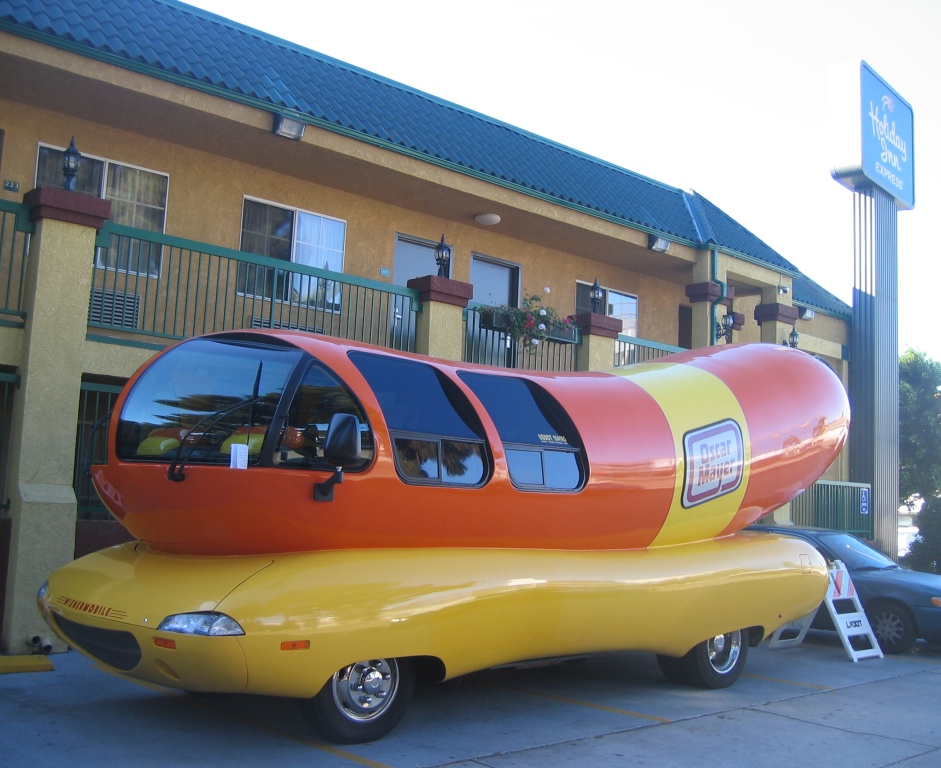
"No, I've never driven the Weinermobile before, but I did stay at a Holiday Inn Express last night..."
Monday, November 27, 2006
We all won't go together when we go... sigh

A few Sundays back, as my girlfriend and I drove to breakfast, we heard a song on the Head Trip program on Indie 103.1. At some point into the song she commented how it sounded like Alphaville's "Forever Young"; I replied that it was that song, apparently being covered by a band called Youth Group. I followed that with a quip about how that's what the original needed: more of a beat.
My recollection of "Forever Young" is colored by the memory from high school, where one of my friends turned in the lyrics to the song as a poetry assignment in English class. It was abject plagiarism, but because the teacher was not familiar with contemporary music of the time, my friend not only got away with it, but got an A. Likely it was the only such grade he received the entire semester.
That is utter digression, but it is what first comes to mind when I hear that song (in any incarnation). It's probably why I recall the lyrics as well as I do.
When hearing the Youth Group cover in the car that day, I thought of the line at the end of the opening verse (or stanza, if we're sticking with the poetry theme) asking "Are you gonna drop the bomb or not?" and how it seemed so archaic in this era of targeted terrorist attacks. The song seemed essentially a wistful rumination on dying at a young age in a nuclear explosion—which, in the early '80s, was still a significant concern for the youth of the world.
There was something more easily romanticized about the possibility of mutually assured destruction. It's not that death was any more glamorous back then; the way we thought of such tragic death was different. Since the '50s the Cold War made for wonderfully dichotomous notions regarding how the possibility of wiping our species off the planet—the literal end of the world—was more likely than ever, which were combined with the strange comfort of knowing that because both sides had ICBMs pointed at each other, if they launched their missiles at us, we would do the same in kind, and thus our demise would be theirs as well, thus making it less likely to actually happen.
Now, we have the constant but indistinct dread from a small but significant number of us could be killed by terrorists. Not only is there no comfort to be gained from retaliation (lacking a convenient target to strike back against), there's no comfort to be found in what was ultimately the comforting aspect of all of us being destroyed in a climactic unleashing of the atom: Some of us have to survive.
Nuclear annihilation carries with it the implication of no survivors. Bear in mind, we're speaking in terms of romanticizing the event; this is not the same as what would actually happen, where some would die quickly and some would die much slower. This is the scenario where the missiles launch and we all have 30 minutes to lose our virginity with the nearest available person, and any actions taken have no consequences. Best of all, we all die together, so no one has to stay around and mourn, nor feel guilty for having survived.
This post-9/11 world hold less potential for "the bomb" to take us all out in one fell swoop. It's less tragic, on that ostensible front, but really it's worse, because there's nothing to romanticize about less than 1% of us dying together. There's only mourning.
Who can write a decent pop song about that? Especially one that'll be covered 25 years from now?
Sunday, November 26, 2006
Something to be thankful for
So last week when I was in North Carolina visiting family we went to Jordan Lake, a large body of water to the south of Durham. Being November it wasn't particularly crowded; in fact, there was only one other person at the area where we stopped.
By the water's edge I spotted a sign, which when I read the text I chuckled aloud and knew I felt compelled to take a picture. When I showed it to my girlfriend she laughed as well and immediately stated, "That's going on the blog."
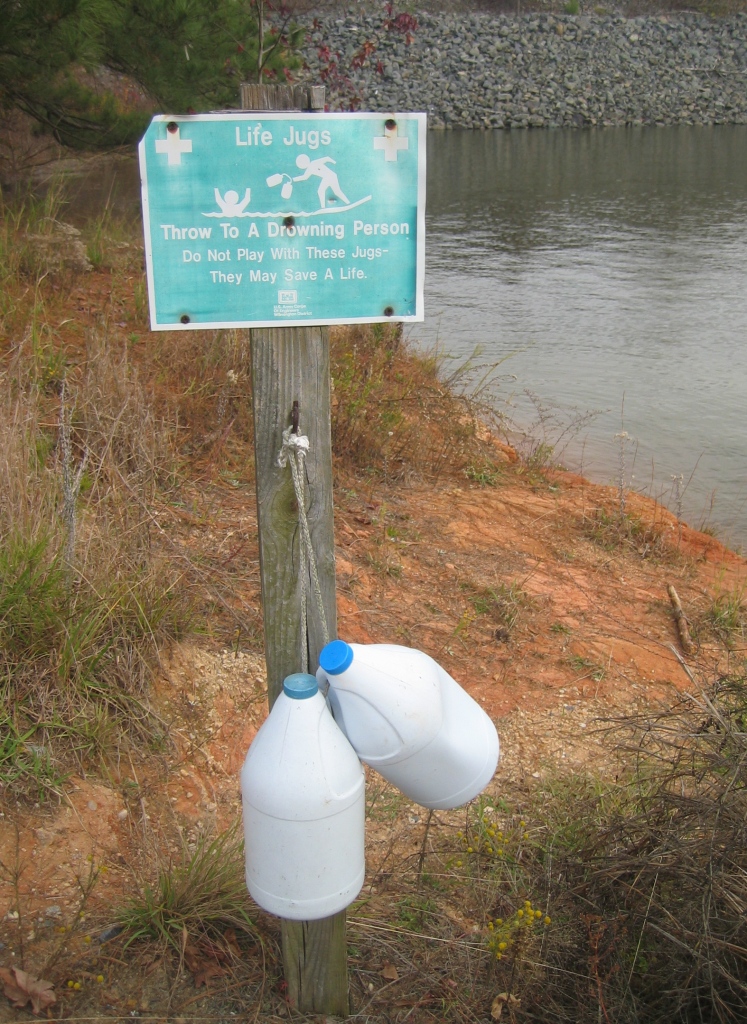
The sign had two empty plastic bottles (like the kind detergent comes in) hanging from it, and the text indicated they should be used to help someone in the water who is in danger of drowning. What possibly could be funny about potentially life-saving equipment?
If you can't make it out from the picture above, the bottles were called "Life Jugs" on the sign, and it carried the admonition:
Surely, this shows the insidious influence of Jay Leno on our society. He'd show that on The Tonight Show after a newspaper clipping of a recently married couple whose respective last names sounded amusing together.
Letterman would get Regis to float with them in a pool of water just off-camera for the entire show, cutting to shots of him getting wrinkled fingers when going to commercial.
Jimmy Kimmell would get his uncle Frank to pester tourists on Hollywood Boulevard with the jugs.
As I had no talk show hosts nor wacky relatives to amuse us while we were at the lake, I merely took the picture.
It's not enhancing society in any worthwhile way, but it's the sort of comedy that at least some of the country finds amusing, so perhaps it will garner me some of the Leno audience by posting it.
It was only a matter of time until I started to sell out.
By the water's edge I spotted a sign, which when I read the text I chuckled aloud and knew I felt compelled to take a picture. When I showed it to my girlfriend she laughed as well and immediately stated, "That's going on the blog."
The sign had two empty plastic bottles (like the kind detergent comes in) hanging from it, and the text indicated they should be used to help someone in the water who is in danger of drowning. What possibly could be funny about potentially life-saving equipment?
If you can't make it out from the picture above, the bottles were called "Life Jugs" on the sign, and it carried the admonition:

Surely, this shows the insidious influence of Jay Leno on our society. He'd show that on The Tonight Show after a newspaper clipping of a recently married couple whose respective last names sounded amusing together.
Letterman would get Regis to float with them in a pool of water just off-camera for the entire show, cutting to shots of him getting wrinkled fingers when going to commercial.
Jimmy Kimmell would get his uncle Frank to pester tourists on Hollywood Boulevard with the jugs.
As I had no talk show hosts nor wacky relatives to amuse us while we were at the lake, I merely took the picture.
It's not enhancing society in any worthwhile way, but it's the sort of comedy that at least some of the country finds amusing, so perhaps it will garner me some of the Leno audience by posting it.
It was only a matter of time until I started to sell out.
Wednesday, November 15, 2006
Grasping at straws to stir this drink
A few weeks back my girlfriend and I hung out with some friends, and at one point in the conversation I told a tale from years ago (but still when I was well into my 30's) of going to a blues bar near where I live and drinking more than I should... on a weeknight. Once.
[Gasp! Shock!]
The story involved me going there by myself on a Tuesday evening after a particularly bad day at the office, intending only to stay for the band's first set and then returning home, but ending up there so long that the bartender was giving me free beers and closing the place down. This resulted in me going to work the next day somewhat hungover, although not really that bad (no one noticed, and it was really no worse than had I not slept well).
For some reason this act imbued me with a sense of rebellion, as though I'd gotten away with something; my straight-laced upbringing was not so strict that I needed to still act out well over ten years after I'd stopped living with parents, but going out by myself to a local blues club on a "school night" seemed to fall into the imprudent category.
Perhaps that straight-laced upbringing planted the seeds for latent compensatory rebellion, but such that it held absolutely no consequences (save a bit of a headache). There is no justifying it to someone who wouldn't understand. However, more important, there is no convincing anyone with an actual life where this not uncommon that the story is worth telling.
There are those who are the age I was at the time (early 30's) who go out every night, and who would have many better stories of debauchery. As I noted toward the end of relating the tale, I have very few stories, but those I have I milk for all I can.
Why would that matter? Surely it implies that there's some empirical standard for what constitutes an interesting life, and going out and having a time that wasn't necessarily that enjoyable at the time (and, as one of the friends interjected, could be seen as kind of pathetic—going to a bar alone) will be compensated later by the enjoyment of having the anecdote to tell; the point of what one does is less about the moment itself and more about portraying the moment later.
Being around other people necessitates having something to talk about, and this sort of tale works better than trying to make what one does at the office seem interesting.
Somehow mildly irresponsible behavior makes one seem more relatable (at least I presume that is its appeal), as it reveals flaws that make others not feel so bad about their flaws. An occasional step down off one's high horse achieves a humanizing effect, or something like that.
It's insecurity, ultimately.
As Halloween recently passed, it made me think of the destructive things that adolescents and teens do on that night, ostensibly out of that same aspiration toward rebellion as what I concluded was behind my midweek drinking incident. Why would it be funny to go around and set Jack O Lanterns on fire by spraying them with something flammable, or to throw rolls of toilet paper over a house and lawn, or stomping on the way someone decorated their house? It's not, of course. However, years later it makes for a delightful anecdote that, with the perspective of having grown out of such juvenile behavior, becomes amusing, and a story one can tell over and over, to make one not seem like such a worthless desk jockey.
It's something to do.
Life is only really good in retrospect, I suppose.
[Gasp! Shock!]
The story involved me going there by myself on a Tuesday evening after a particularly bad day at the office, intending only to stay for the band's first set and then returning home, but ending up there so long that the bartender was giving me free beers and closing the place down. This resulted in me going to work the next day somewhat hungover, although not really that bad (no one noticed, and it was really no worse than had I not slept well).
For some reason this act imbued me with a sense of rebellion, as though I'd gotten away with something; my straight-laced upbringing was not so strict that I needed to still act out well over ten years after I'd stopped living with parents, but going out by myself to a local blues club on a "school night" seemed to fall into the imprudent category.
Perhaps that straight-laced upbringing planted the seeds for latent compensatory rebellion, but such that it held absolutely no consequences (save a bit of a headache). There is no justifying it to someone who wouldn't understand. However, more important, there is no convincing anyone with an actual life where this not uncommon that the story is worth telling.
There are those who are the age I was at the time (early 30's) who go out every night, and who would have many better stories of debauchery. As I noted toward the end of relating the tale, I have very few stories, but those I have I milk for all I can.
Why would that matter? Surely it implies that there's some empirical standard for what constitutes an interesting life, and going out and having a time that wasn't necessarily that enjoyable at the time (and, as one of the friends interjected, could be seen as kind of pathetic—going to a bar alone) will be compensated later by the enjoyment of having the anecdote to tell; the point of what one does is less about the moment itself and more about portraying the moment later.
Being around other people necessitates having something to talk about, and this sort of tale works better than trying to make what one does at the office seem interesting.
Somehow mildly irresponsible behavior makes one seem more relatable (at least I presume that is its appeal), as it reveals flaws that make others not feel so bad about their flaws. An occasional step down off one's high horse achieves a humanizing effect, or something like that.
It's insecurity, ultimately.
As Halloween recently passed, it made me think of the destructive things that adolescents and teens do on that night, ostensibly out of that same aspiration toward rebellion as what I concluded was behind my midweek drinking incident. Why would it be funny to go around and set Jack O Lanterns on fire by spraying them with something flammable, or to throw rolls of toilet paper over a house and lawn, or stomping on the way someone decorated their house? It's not, of course. However, years later it makes for a delightful anecdote that, with the perspective of having grown out of such juvenile behavior, becomes amusing, and a story one can tell over and over, to make one not seem like such a worthless desk jockey.
It's something to do.
Life is only really good in retrospect, I suppose.
Subscribe to:
Posts (Atom)